


BGP Design Principles for Scalable Enterprise Networks
- The Itvue Team
- Aug 20, 2025
- 2 min read
Author Ermias Teffera
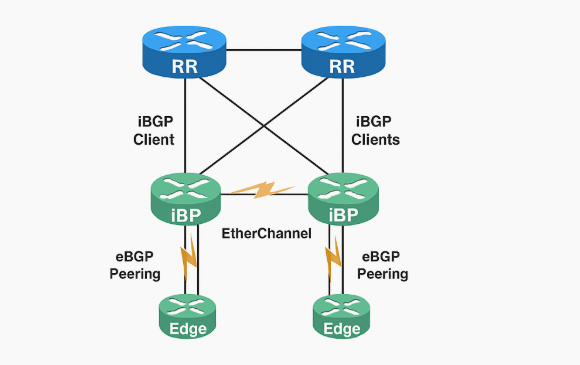
At ITVue Networks, we focus on building robust, scalable, and high-performance networks. BGP (Border Gateway Protocol) is the backbone of enterprise and service provider routing, and designing it properly ensures resilience, fast convergence, and optimal traffic engineering. This blog outlines key BGP design principles based on a hierarchical network with route reflectors, iBGP clients, and eBGP external peers.
1. Hierarchical iBGP Design
Route Reflectors (RR)
Centralized routers that reduce the full-mesh requirement of iBGP.
RRs reflect routes to client routers, maintaining consistent routing without requiring every iBGP router to peer with all others.
Helps scale large enterprise networks with many routers.
Best Practices:
Use at least two RRs per area for redundancy.
Separate RRs for different locations if the AS is geographically large.
Avoid having RRs as clients of each other to prevent loops.
iBGP Clients
Routers within the AS that receive BGP updates from RRs.
Do not need to peer with every other router in the AS.
Simplifies network topology while maintaining route consistency.
Best Practices:
Ensure all iBGP clients receive updates from at least one RR.
Prefer dual-homed clients connected to multiple RRs for redundancy.
2. eBGP Connectivity
eBGP peers connect to external autonomous systems (ISPs, partners).
Provides Internet access and inter-AS connectivity.
Typically connects via distribution or edge routers.
Best Practices:
Configure BGP session policies (local preference, AS path prepending, communities) to control outbound and inbound traffic.
Use multiple eBGP peers for redundancy and load balancing.
Monitor sessions with show ip bgp summary.
3. Route Aggregation and Summarization
Summarize internal prefixes before advertising to eBGP peers to reduce the global routing table size.
Reduces unnecessary propagation of detailed internal routes.
Best Practices:
Aggregate at distribution or edge routers.
Avoid over-aggregation that could hide network reachability.
4. Traffic Engineering and Policies
Use local preference to influence outbound traffic within the AS.
AS path prepending can manipulate inbound traffic from external peers.
BGP communities allow flexible route tagging for policy enforcement.
5. Redundancy and High Availability
RRs should be deployed in pairs for failover.
iBGP clients can be dual-homed to multiple RRs or use ECMP for multiple equal-cost paths.
Edge routers can use ECMP for load balancing across multiple eBGP peers.
EtherChannel can be used between distribution and core routers to aggregate bandwidth and provide link redundancy.
6. Scalability Considerations
Use RRs and possibly confederations to reduce iBGP full-mesh complexity.
Monitor routing table growth and L2/L3 link utilization.
Plan AS numbers and route policies carefully to prevent loops and inconsistencies.
Cisco Configuration Example
iBGP with Route Reflector

eBGP Peer

Real-World Example
Core RRs handle route reflection for all iBGP clients.
Distribution routers are iBGP clients and advertise summarized internal prefixes.
Edge routers peer with multiple ISPs via eBGP with ECMP paths.
EtherChannel links connect distribution to core routers, providing bandwidth aggregation and redundancy.
Conclusion
Proper BGP design is essential for resilient, scalable, and high-performing networks. By following these principles—using route reflectors, confederations, route summarization, policy-based routing, ECMP, and EtherChannel—ITVue Networks ensures enterprise and service provider networks remain robust, efficient, and future-ready.


Comments